Sorry about the silence. I have been busy. If you... | Reviews / Books | Coagulopath
Sorry about the silence. I have been busy. If you haven’t heard the news, my Hollywood career recently didn’t skyrocket. I have been not cast in Black Widow 2, and not rehearsing for this film now occupies the majority of my time. I can’t wait for you to not see me acting alongside Scarlett Johansson. The film’s script does not contain a sex scene between us, and Ms Johansson did not whisper that perhaps we could violate SAG-AFTA rules and perform it unsimulated, and I have not decided whether to not be lead by my head or my heart on this issue. Let’s talk about My Terrible Life by Sunny McCreary.
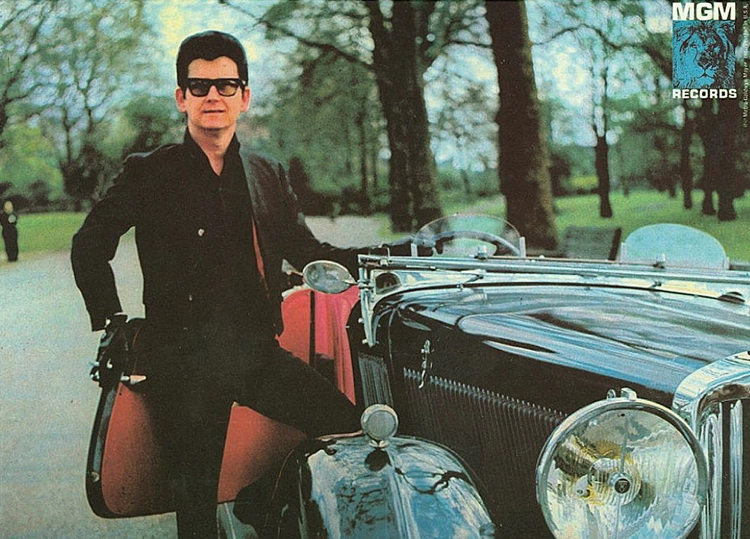
McCreary is a pen name of Michael Kelly, an online humorist who went viral in nineteen-ninety-$DATE with Roy Orbison in Clingfilm. These surreal vignettes describe German citizen Ulrich Haarbürste, who is a fan of rockabilly legend Roy Orbison, wrapping his idol in clingfilm.
It always starts the same way. I am in the garden airing my terrapin Jetta when he walks past my gate, that mysterious man in black.
‘Hello Roy,’ I say. ‘What are you doing in Dusseldorf?’
‘Attending to certain matters,’ he replies.
‘Ah,’ I say.
He apprises Jetta’s lines with a keen eye. ‘That is a well-groomed terrapin,’ he says.
‘Her name is Jetta.’ I say. ‘Perhaps you would like to come inside?’
‘Very well.’ He says.
Roy Orbison walks inside my house and sits down on my couch. We talk urbanely of various issues of the day. Presently I say, ‘Perhaps you would like to see my cling-film?’
‘By all means.’ I cannot see his eyes through his trademark dark glasses and I have no idea if he is merely being polite or if he genuinely has an interest in cling-film.
I bring it from the kitchen, all the rolls of it. ‘I have a surprising amount of clingfilm,’ I say with a nervous laugh. Roy merely nods.
‘I estimate I must have nearly a kilometre in the kitchen alone.’
‘As much as that?’ He says in surprise. ‘So.’
‘Mind you, people do not realize how much is on each roll. I bet that with a single roll alone I could wrap you up entirely.’
Roy Orbison in Clingfilm stories stick to your brain like leeches. Even if you don’t laugh, you also don’t forget. Taking a stab at why, it’s because they’re so specific.
Every detail is memorable. Ulrich Haarbürste (lit: “Hairbrush”) is a funny name. Germany (aside from 1933-1945 and some select periods before and after) is a funny country. Haarbürste’s writing is strange, possessing the grammatically correct yet “wrong” register of an educated man who has learned English as a second language. A terrapin is an unusual pet, and “Jetta” an incongruous name for one (cars are known for being fast, turtles are known for being slow.)
And although Roy Orbison is portrayed as a willing (if occasionally reluctant) partner in Ulrich Haarbürste’s games, the idea of a fan wrapping a celebrity in clingfilm is peculiar and evokes the behavior of the Bjork stalker (a psychosexual desire to possess and control and objectify). And at least Bjork is an attractive woman, while Roy Orbison—who achieved fame in the 60s, was stomped flat by the British Invasion, and then staged a latter-day comeback—was a weedy, gangly, jug-eared man (it was laughable whenever a photographer posed Orbison next to a sexy car: he looked like a Make-A-Wish kid whose dying request was to be James Dean.) Making him the target of Haarbürste’s obsession is yet another individualistic fingerprint in a crime scene full of them. Specificity = good. Genericity = bad.
Am I explaining the obvious? Probably, but it eludes most writers, who hate specificity like it murdered their puppy. It’s believed now that writing must be “relatable”: your story should be set in Anytown USA, starring a character exactly like the reader. No deviation is allowed: if you describe your hero as enjoying marmalade on his toast (so the thinking goes), you’ve alienated the book-reading section of the market that prefers jam on theirs. And since you cannot predict the tastes of nine billion people, the only solution is to write characters with no traits at all.
Think of Harry Potter. He has no personality. JK Rowling actually writes good characters most of the time: Ron Weasley and Hermione Granger are incandescent on the page, and even controversial later additions like Stepin Fetchit the House Elf, Shlomo Shekelstein the Goblin Banker, and the Trans Bathroom Molester are vividly memorable. Harry, however, is boring. He is not an interesting person, he is a person that interesting things happen to. I read the The Deathly Hallows‘s final chapter with a sense of embarrassment. “Wait, you think I care about Harry’s life after he defeats Voldemort?”
Online, we see too many attempts to recapture whatever Roy Orbison in Clingfilm had. Most fail, because they’re too general, too “relatable”, too Harry Potter. They take the form of “I’m a 20 year old boy with a hot sister and [something wacky happens]”. They cast too wide a net and lack the sting and punch of the particular. They do not contain terrapins called Jetta.
I was delighted to discover that Michael Kelly has a website (and book) full of Roy Orbison in Clingfilm stories. I was also delighted to discover that this is not his best work. Not by a long shot!
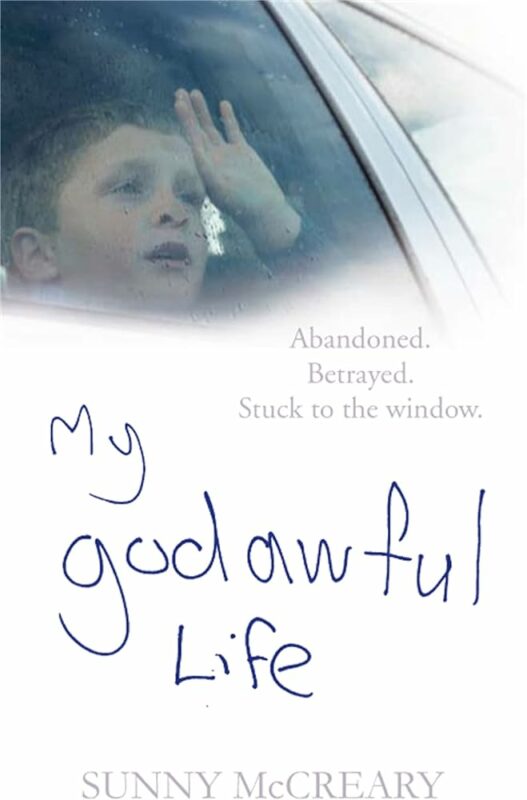
One of his many projects is My Godawful Life. Which I haven’t discussed at all.
Kept in a bird-coop by his parents, Sunny McCreary endured a childhood of neglect, abuse and being bullied by pigeons, only to find it was all downhill from there. In the course of the most painful life ever, he survived tragedy and maiming, a savage convent school education, being pimped out in pink-satin hot pants, a degrading addiction to helium, and having a baboon’s arse grafted onto his face. Then things got really bad.
This book is a parody of “misery lit” such as Dave Pelzer’s A Child Called It. These books, with their combination of luridly-described child abuse and sanctimonious hustle-positivity (“as my stepfather shoved my entire face into a woodchipper, I reflected that each day is a blessing from God”), provide a satirical target a mile wide, but what monster would mock the memoirs of abused children? The same monster who would wrap Roy Orbison in clingfilm, that’s who.
The book is so goddamn funny it’s unreal. It just keeps going and going and going. You’d think the joke would get played out somewhere around page zero, but it never does. Each chapter has a new outrage, a new horror, a new source of ridiculousness. The part where Sunny halfheartedly attempts suicide by jumping in front of parked cars and out of ground-floor windows.
Mr Kelly seems to have soured on the book. Which is a shame. It’s great!
[Edit, 2013: I repent this now, in fact I would pretty much like to forget I wrote it. It has moments of inspiration but it also has moments of the most appalling playground crassness. I would still maintain the things I was parodying are worse, but it crosses lines, sometimes with purpose but sometimes gratuitously, and what was bracing in the original five-page bit becomes wearing stretched to 300. Also, I wanted it to be more than a rag-bag of sick jokes, so it’s a rag-bag of sick jokes that develops delusions of grandeur.
What are these delusions of grandeur?
Well, midway through, Sunny adopts an autistic child with “Tourettes” called Euphemia. (I don’t exactly remember the circumstances: I’m reviewing this from memory because I gave my only copy away to a girl who has now moved far away from me for reasons which may or may not be related.) I find “genius child” tropes tedious, and was expecting and hoping for her to die. She doesn’t, and gradually mutates into arguably the book’s most vivid character.
Euphemia provides another source of comedy, but also acts as a foil to Sunny: pushing and provoking him to leave his shell. They fight a lot, but in the end form a good pair. Their interplay adds a lot of muscle and fiber to the book (which, I’ll admit, is mostly one note banged on a piano over and over.) The final couple of chapters are actually written by Euphemia, and basically address the phenomenon of misery lit head on, without a satiric voice. There is great evil in the world. But there’s also a force adjacent to great evil: a force that compels people to watch and stare and rubberneck at car accidents and enjoy outrage and misery. Suffering as entertainment. Is there something wrong with people who buy and read misery lit? Michael Kelly seems to think there is, and I would agree. It inspires the same revulsion in me as people who have sex with their furniture: even if the act itself isn’t wrong, enjoying it indicates there’s something wrong with the actor. The book might embarrass Kelly now, but it has only become more and more relevant, as this stuff continues to encroach into the mainstream.
Kim Jong Il was Supreme Leader of North Korea. He... | Reviews / Books | Coagulopath
Kim Jong Il was Supreme Leader of North Korea. He was also a prolific writer. Wikipedia tells us that “Kim published some 890 works during a period of his career from June 1964 to June 1994”. That sounds like a lot, though I hear most of those books were actually vampire/werewolf erotica.
This particular book is adapted from a speech the man gave in 1991, in the midst of the crash of the Soviet Union. It’s 54 pages in length, so quite a long speech—I hope nobody had to go to the bathroom. I read it to learn about the Juche school of Marxist-Leninism, and was disappointed. Kim Jong Il is not one for boring the audience with theory. His descriptions of how the Juche system works all go like this:
The Juche idea is a man-centred outlook on the world. It has clarified the essential qualities of man as a social being with independence, creativity and consciousness. It has, on this basis, evolved the new philosophical principle that man is the master of everything and decides everything.
The Juche idea has raised man’s dignity and value to the highest level.
In our socialist society, which is the application of the man-centred Juche idea, the interests of every individual are respected.
Because it is the embodiment of the Juche idea, our socialism is a man-centred socialism under which man is the master of everything and everything serves him.
Fluffy stuff. I am reminded of the time Neil deGrasse Tyson proposed a nation called “Rationalia”, with just one line in its constitution. “All policy shall be based on the weight of evidence.” It’s really easy to run a country: just make laws based on evidence. While I’m relieved that there’s such a simple road to paradise, in practice there seem to be devils lurking in the details. Likewise, a founding principle of “man is the master of everything” sounds good, but what does it mean? Is man also the master of other men? I suppose North Korea is a eighty-year experiment in answering that question with “yes”.
Hitler’s Mein Kampf isn’t my favorite book—it’s dull, and has some problematic bits (he repeatedly calls Joseph Stalin an “autistic [r-slur]”, and the chapter spent discussing his favorite anime shows is beyond the pale), but it’s big and hefty. There’s the implication of thought behind it. Even if it’s mad thought, it’s a believable and credible basis for a movement. You could use the hardback edition of Mein Kampf to club an enemy to death.
Kim Jong Il’s writing falls to the other extreme. Although light and readable, it displays no evidence of thought whatsoever. It’s just rah-rah feelgood nice stuff, emptily asserting that the Juche philosophy means certain things, regardless of how improbable or self-contradictory they might be.
Socialism is a new social system which differs fundamentally from all the exploitative societies that have existed in human history. As such, it has to blaze a trail despite fierce struggles against the class enemies. Therefore, it may meet with transient setbacks in its progress. However, mankind’s advance along the road of socialism is a law of historical development, and no force can ever check it.
To be honest, it doesn’t “read” like something a Marxist-Leninist would write: it has the prose style of a tech CEO who hires PR firms to scrub his Wikipedia page of sexual harassment allegations. You could not beat an enemy to death with Our Socialism Centered On the Masses Shall Not Perish. Whack someone with this book and they would gain life-force somehow. Wrinkles would mysteriously disappear from around their eyes. The spring would return to their step. Only by staring at the page through a microscope can you discern any influence from, say, Hegel (note that the rise of socialism isn’t a fact contingent on particular circumstances, it’s a law. But somehow we still have to fight for it…).
The book swings like a weathervane from the banal to the palpably absurd.
The Juche idea’s approach towards people of different classes and strata is that they should be judged by their ideas and actions
The pampered heir apparent of North Korea, gifted hundreds of totally undeserved jobs, positions, and titles by his father—could actually write (and say) this without provoking gales of laughter. Such was his power. I think I would prefer to live in a society that’s openly tyrannical and reft by classism, rather than a variant of the same that hides tyranny under classlessness. I can’t find the tweet that went something like “At least medieval peasants weren’t subjected to the humiliating fiction that their king wanted to have a beer with them.”
Pictured: a brave Hillary Clinton ventures into the house of a common person
It appears that Juche’s main point of disagreement with mainline Marxist-Leninism is its emphasis on North Korean independence and national identity. It’s an isolationist cover of a familiar tune. The very first line of the book is “WORKING PEOPLE OF THE WHOLE WORLD, UNITE!”, but Juche socialism was not based on any sort of global class unity. So far as Kim Jong Il was concerned, the working people of the world could go pound sand, jump in the sea, and throw a flying fuck at a rolling donut. Juche was about improving the standing of North Korea. One family in North Korea in particular.
This speech was made in 1991, when North Korea was clearly rotten to the core. Half a decade later, wracked by famine and stripped of Soviet aid, it had become possibly the worst place in the world. Kim Jong-Il would later refer to these years of starvation as “arduous march”; a hiking trip to some glorious destination that some citizens (perhaps three million) were regrettably not fit enough to survive. He still found ways to enrich himself. A slogan I remember from this book is “When the Party is determined, we can do anything!” He should have said “I can do anything”.
But again, you have to give Kim Jong Il his due. This is not a book, it’s a speech, printed and sold as a book for some reason. What can you expect? And it’s not like the audience had to be convinced. They were already “pre-sold”: maybe at bayonet point, that the Juche system kicked ass. Even though there may not have been a Juche system at all, just a blank unwritten idea that allowed the Kim dynasty—Sung Il, Jong Il, and now Jong Un—to impose their real ideas on their people.
You can either read this book or avoid it. There’s not much to it, either. It’s just 54 pages, and that’s with the lines of text ludicrously double-spaced, like a padded college essay. Those empty spaces should be funny, but they’re not. I gaze into them and unpleasant images flood out. Each seems to have starved and rotting bodies inside it.
Ballard described Crash as a “pornographic novel based on technology”.... | Reviews / Books | Coagulopath
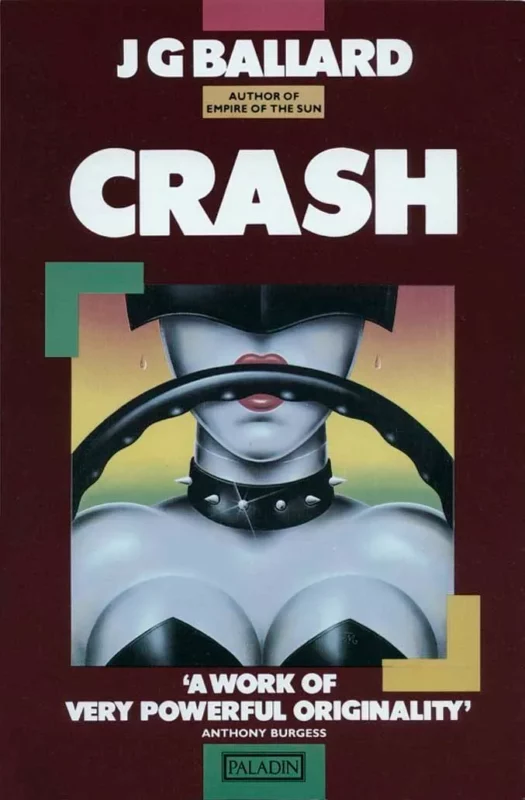
Ballard described Crash as a “pornographic novel based on technology”. It could also be called a pornographic novel based on math. But is there any other kind? All porn is mathematical, because sexual desire is mathematical. Follow the tidal pull of lust, passion, and desire back to its source, and you will find, not a mystery of the heart, but a number. A certain amount of visual stimulus. A certain excitatory threshold to neurons. A certain amount of blood flow to the genitals. Whatever mystic significance we attach to eroticism, we’re ultimately aroused by numbers. Math: the universal fetish.
On the internet, math-fetishism becomes incredibly literal. Porn sites dismember girls as if with a buzzsaw, reducing them to heaps of bloody numbers. What is the essence of Mia Malkova? According to Boobpedia, it’s 34″ (bust), 26″ (waist), 36″ (hips), 5’7″ (height), 123lb (weight), and so on. These sites barely have any pictures of girls, just numbers and numbers and more numbers, as though female flesh is just an tediously necessary scaffolding for hot hot hot math. It’s disturbing: men calculating themselves into an orgasm.
Crash is a postmodern effort at explicating this sex-math link—although not it’s not the Imperial math of a seamstress, but the metric math of a structural engineer. It eroticizes mechanical destruction, portraying a community of “symphorophiliacs” who are aroused by car accidents, and seek to exist forever inside the moment of impact—the shattered glass halo exploding out over the road, the steel momentarily flowing like liquid, assuming a new position around (and through) the occupant’s body like a twisted cocoon. But how can these people exist in a world that’s exactly one heartbeat long? And which so often kills the participant?
Because they don’t. Symphorophiliacs aren’t real. Or they’re real but very rare; a Google search returns only dictionary definitions and results relating to Crash. The internet is an agar plate exhibiting all manner of bizarre fetishes—girls with giraffe necks, girls sinking in quicksand, Christina Hendricks photoshopped to be blue—but car crash aficionados seem hard to find.
Maybe Ballard thought that basing a book on a nonexistent (or barely existent) fetish would lead to fewer outraged letters (“Mr Ballard, your book promotes offensive and harmful stereotypes about our lifestyle…”) But there’s also something intrinsically Ballardian about car accidents. Like sexual desire, they are complex but ephemeral: like smoke rising from an math-fire. If you die on the road tonight, it will be because a number was wrong. A break pad wore 1 mm too thin. The friction coefficient of a tire against wet asphalt fell beneath some threshold. A truck driver slept for six hours instead of seven. This is true for any car accident in history, whether it’s James Dean’s, Jayne Mansfield’s, or the one that crippled my father. Whatever elaborate flowers of pain and heartbreak crawl from this dark soil, they are fertilized by slightly wrong numbers. In a similar vein, Crash is a porn narrative that’s slightly off. An android would not find it repellant. It might be more disturbed by the descriptions of conventional sex. As with Ballard’s Why I Want to Fuck Ronald Reagan, it’s built on taking well-worn synaptic pathways—Cars! Fucking!—and twisting them until they appear monstrous and alien. Often, it doesn’t take much twisting at all.
Crash’s (tiny) story involves a man who shares the author’s name. Having survived a car accident, he falls in with a gang of car crash fanatics, led by one Robert Vaughan. These are an odd bunch. Their bodies are wracked and twisted by many accidents. Their minds are worse. They drool over scientific papers with names like “Mechanisms of Occupant Ejection” and “Tolerances of the Human Face in Crash Impacts”. They meet on moonlit roads to restage historic car accidents, acting out the roles of Camus and Kennedy and Mansfield and Dean. Sometimes method-acting, if you catch my drift.
Vaughan (“nightmare angel of the expressways”) is one of the bleaker and more ambiguous figures in literature. His name is faintly suggestive of a car brand (Vauxhall. Vespa. Volkswagen. Volvo), and his stated profession of “TV scientist” sounds like a fake job created by a fibbing child on the playground (“your dad works at Nintendo? Ha! Mine’s a TV scientist!”). There are a few textual clues that Vaughan may not even exist—that he could be a Tyler Durden sort of figure, created by the narrator to express ideas that he is too afraid to own.
I saw no more of Vaughan. Ten days later he died on the flyover as he tried to crash my car into the limousine carrying the film actress whom he had pursued for so long. Trapped within the car after it jumped the rails of the flyover, his body was so disfigured by its impact with the airline coach below that the police first identified it as mine. They telephoned Catherine while I was driving home from the studios at Shepperton. When I turned into the forecourt of my apartment house I saw Catherine pacing in a light-headed way around the rusting hulk of Vaughan’s Lincoln. As I took her arm she stared through my face at the dark branches of the trees over my head. For a moment I was certain that she had expected me to be Vaughan, arriving after my death to console her.
We had heard nothing of Vaughan since he had taken my car from the garage. Increasingly I was convinced that Vaughan was a projection of my own fantasies and obsessions, and that in some way I had let him down.
Descriptions of Vaughan’s “death” bookend the novel at front and back. His dual-obliteration spent “drowning in his own blood under the police arc-lights” is the book’s framework, two steel pins holding together a shattered bone of manuscript. “James Ballard” has found his people. He might not be with them for long. Not long after Vaughan’s real or imagined demise, he starts planning his own car crash. Not a car crash, the car crash. The final one. For hundreds of pages in between Vaughan’s death, we are treated to many descriptions of smaller accidents, related in Ballard’s chrome-iridescent prose.
Vaughan propped the cine-camera against the rim of the steering wheel. He lounged back, legs apart, one hand adjusting his heavy groin. The whiteness of his arms and chest, and the scars that marked his skin like my own, gave his body an unhealthy and metallic sheen, like the worn vinyl of the car interior. These apparently meaningless notches on his skin, like the gouges of a chisel, marked the sharp embrace of a collapsing passenger compartment, a cuneiform of the flesh formed by shattering instrument dials, fractured gear levers and parking-light switches. Together they described an exact language of pain and sensation, eroticism and desire. The reflected light of Vaughan’s headlamps picked out a semi-circle of five scars that surrounded his right nipple, an outline prepared for a hand that would hold his breast.
The entire book is written like this. Long erotic paeans about the least erotic things imaginable. The plot is minimal, because it’s porn—how much backstory does the pizza delivery guy in a Skinemax flick really need?—and instead the interest is thrown toward’s Ballard’s creative juxtopositions. Shaft sticks compared to erections. Semen in dead testicles compared to cooling engine fluid. That sort of thing. The endless detail is sort of enervating, but also sort of inspiring.
Many horror writers describe their universe as little as possible—Lovercraft’s old line about “the inability of the human mind to correlate all its contents”—but Ballard was a rare exception. He didn’t just try to describe the alien, he tried to capture it, like a bug in a glass jar, and he often succeeded in doing so. Crash does feel exquisitely foreign. But the question remains: do you want to read 300 pages of this?
I remember my first minor collision in a deserted hotel car-park. Disturbed by a police patrol, we had forced ourselves through a hurried sex-act. Reversing out of the park, I struck an unmarked tree. Catherine vomited over my seat. This pool of vomit with its clots of blood like liquid rubies, as viscous and discreet as everything produced by Catherine, still contains for me the essence of the erotic delirium of the car-crash, more exciting than her own rectal and vaginal mucus, as refined as the excrement of a fairy queen, or the minuscule globes of liquid that formed beside the bubbles of her contact lenses. In this magic pool, lifting from her throat like a rare discharge of fluid from the mouth of a remote and mysterious shrine, I saw my own reflection, a mirror of blood, semen and vomit, distilled from a mouth whose contours only a few minutes before had drawn steadily against my penis.
Sexual kinks are fascinating when you have them, dull when you don’t. And this is a fetish nobody has. It’s porn that forces the reader into compulsory asexuality. So why has Crash become a classic? What emotions does it rouse?
Initially, disgust. But soon even this recedes behind a stronger (though less acute) kind of horror. The actions are fucked up; but so’s the fact that someone would spend so many pages describing them. We live in a strange world. All these people have a dark bruise punched into their brain, one so dark it’s like a black hole, consuming first their thoughts and then their existence. Of course they love accidents. That’s what they are.
But 224 pages is a long time to spend in this world, and with these people. There’s no real evolution or change to the fractured-metal narrative. Crash is aptly named: it has all the forward momentum of an Aston Martin wrapped around a tree. The book presents a single, unvarying scenario. At times, the pages and chapters seem like they could be jumbled around in any order.
Ballard clearly intended the book as social commentary about car-obsession (from the foreword: “Crash, of course, is not concerned with an imaginary disaster, however imminent, but with a pandemic cataclysm that kills hundreds of thousands of people each year and injures millions.”). But this doesn’t really land: the book’s so weird and out there that it never truly feels like it’s striking a nerve. Yes, cars kill hundreds of thousands of people. But this isn’t because of some timeless Freudian death drive, but because there are a lot of cars and a lot of people and a lot of carelessness. Because of math, in other words. And this is not some horrible technological fate accompli that’s an inevitable consequence of the world we live in. We could easily make cars safer and laws saner. Then fewer people would die.
Furthermore, twisting human sexuality around cars seems a bit interesting. Yes, there are similarities between lust and the emotions roused by cars. But are they really a match? Sexual desire is timeless and atavistic. Cars are a techno-toy that didn’t exist for most of human history. There’s no symmetry here. Why cars?
Probably because the story’s not really about cars. It’s about the things a car symbolizes. Freedom. Mobility. Power. These are timeless desires that we hug close, even when they’re stinging us to death. Cars are just boxes strapped to wheels. They attain something more by the parts of ourselves we invest into them. We are the cars.
All of the good things a car offers is matched by a correspondingly steep cost. They let you be free…but sometimes they make you unfree—they turn you into a prisoner, shackled to a hospital bed, a wheelchair, a coffin. The sex appeal of sports cars is matched by a complete loss of sex appeal—car crash survivors often have horrific scarring and mutilation. The open air blowing in through your convertible top is matched by the poison billowing out behind. So there’s a dichotomy to car ownership. “Fast cars and fast women” turns into “wrecked cars and dead women” as quickly as a Vauxhall crosses the median strip. The faster you go, the faster you stop when you hit a wall.
One thing stands out about Crash, and its endless autopsies of metal and flesh. Huge slabs of books are actually about celebrity worship instead. Vaughan’s sick flock continually re-enacts the last moments of celebrities—at first this feels like a distraction from the book’s “real” purpose, but then you wonder if it is the book’s true purpose. Nobody cares about cars, just about what they symbolize: if you own a luxury car, you are rich, have abundant leisure time, and high sexual market value. All of these people are living out a fantasy where they are someone famous, using the cars as a “hook to hang your hat on”. After all, not everyone has James Dean’s haunting parasocial affect or Jayne Mansfield’s cans, but a violent death splattered into a dashboard is a fate no man is too poor to buy. Vaughan’s followers are role-playing as celebrities through the only means available to them: car accidents.
So that’s Crash. Flawed, somewhat overlong and overrated, but definitely compelling. Ballard has other, better work, but this is him at his strangest, most fearless, least endurable, and most alien. Crash and burn after reading.